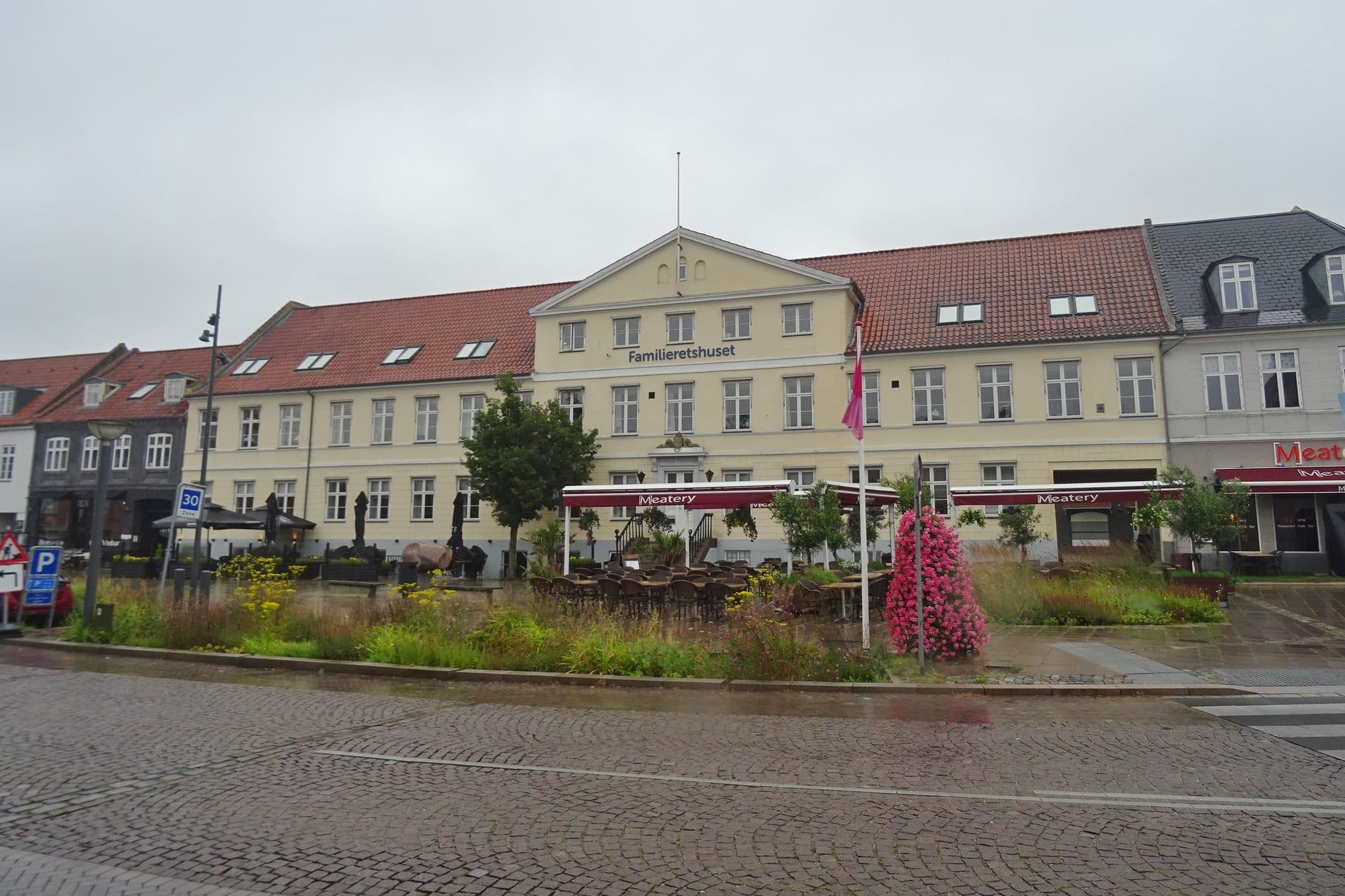

Familieretshuset is Denmark's state family law authority. If you are a couple from abroad who want to marry in Denmark, it checks whether you meet the Danish conditions for marriage and issues the marriage approval, the prøvelsesattest. The application is online, costs DKK 2,100 (about €281) and, with complete documents, is usually decided within 5 working days. The wedding date is then given by the municipality, not by Familieretshuset.
What is Familieretshuset?
Familieretshuset opened on 1 April 2019 and replaced the former State Administration (Statsforvaltningen). On the same date, a new law moved the examination of marriage conditions for international couples from Statsforvaltningen to Familieretshuset. Guides and leaflets that still mention Statsforvaltningen are therefore out of date.
The authority handles almost everything that concerns families in Denmark: custody and contact, child support, paternity, names, adoption, separation and divorce, guardianship and the examination of marriage conditions. For you, only the department for international marriages (Internationale ægteskaber) matters.
You will see the authority under several names. In English it is the Agency of Family Law, which many agencies and forums shorten to AFL. On its German website it calls itself “Die Familienrechtliche Behörde”. It is always the same body. Familieretshuset has offices in nine Danish towns, but it only accepts letters at its postal address in Ringkøbing. You do not need to go anywhere in person for the wedding approval: the application is entirely online.
Who has to apply to Familieretshuset, and who doesn't?
Section 13 of the Danish Marriage Act decides this: Familieretshuset carries out the examination whenever not each of you meets one of these conditions: Danish citizenship, citizenship of another Nordic country (Finland, Iceland, Norway, Sweden), a permanent residence permit in Denmark, or a permanent right of residence in Denmark under EU rules. If each of you meets one of them, you apply to a Danish municipality (kommune).
| Your situation | Responsible |
|---|---|
| Two Germans, Austrians or Swiss without residence in Denmark | Familieretshuset |
| One of you from the EU or Switzerland, the other from a country outside the EU | Familieretshuset |
| One of you lives in Denmark on a temporary residence permit | Familieretshuset |
| Each of you is Danish or Nordic or has a permanent right of residence in Denmark | Municipality |
So for almost all couples from Germany, Austria and Switzerland, Familieretshuset is responsible, even if both are EU citizens. Whether this applies to you and which documents your case needs is shown by our free eligibility check. How marrying works without any residence in Denmark is explained in our guide Marrying in Denmark without residence.
What does Familieretshuset check?
The examination follows Danish law, even if different rules apply in your home country. The Danish Marriage Act sets these conditions:
- Age: You must both be at least 18. There are no exceptions.
- Not married: Any earlier marriage must have ended, by divorce, death or annulment, and you must prove it. Familieretshuset only asks for a certificate of civil status when there is a specific need; otherwise you both declare with your signature, under criminal liability, that you are unmarried. More in our guide Certificate of marital status for Denmark.
- Not closely related: Relatives in a direct line and siblings may not marry each other.
- Guardianship: If one of you is under guardianship, the guardian must consent.
- Lawful stay: You must both enter Denmark lawfully and be lawfully present on the day of the wedding, for example as EU, EEA or Swiss citizens, as citizens of a visa-free country, with a visa, or with a residence permit from a Schengen country. Someone who is only present because of a pending asylum case in Denmark or another Schengen country does not meet this condition, according to the Danish guidance. How to prove your stay since 10 April 2026 is explained in our guide EES proof of legal stay for your wedding.
- No sham marriage: The marriage may not take place if there are specific reasons to believe that its main purpose is a right of residence in Denmark, the EU, the EEA or Switzerland. That is why Familieretshuset asks, for example, how long you have known each other, where you met, whether you have children together and whether you live together. It can ask for unedited photos of you as a couple or invite you to a meeting. What counts is explained in our guide Proof of relationship and the sham marriage check.
On top of that, your documents are checked: Familieretshuset has to be able to judge whether foreign documents are genuine. Depending on the issuing country, they therefore need an apostille or a legalisation. Documents that are not in Danish, English, German, Norwegian or Swedish must be translated by an authorised translator before you apply, including the apostille. Which countries need what is shown in our apostille and legalisation country list 2026.
How does the Familieretshuset application work?
- Prepare your documents. You need colour photos of every page of your passport, including blank pages and the cover; EU citizens can upload both sides of their national ID card instead. Add proof of your lawful stay and, depending on your case, the divorce or death certificate from an earlier marriage, birth certificates of joint children and, if you live together abroad, a certificate of residence. The full list is in our guide Documents for the wedding in Denmark.
- Fill in the online form. If you have MitID, you must use it; everyone else creates a profile with their e-mail address in the form. Each of you completes your own part.
- Pay the fee. You pay the DKK 2,100 when you sign and submit, for example by card, Apple Pay, Google Pay or MobilePay. The examination does not start before that. Once submitted, the fee is not refunded, not even if the application is refused.
- Wait for the receipt. You receive a receipt through Digital Post or at the e-mail address in the application. That confirms the application has arrived.
- Examination. Familieretshuset checks four things: whether both parts of the application are in, whether the fee has been received, whether all necessary documents are there, and whether you meet the conditions.
- Decision. If everything is in order, the authority issues the prøvelsesattest and sends it to the municipality you named in the application. If something is missing, you receive a request for further documents.
Apply yourselves or with an agency?
Both are allowed. If someone helps you, for example a family member or an agency, you give them a power of attorney with original signatures from both of you; it is submitted together with the application, and the representative uses the same online form. It does not make the application faster: the processing time depends on whether it is complete, not on who submits it. The pros and cons of an agency are compared in our guide Getting married in Denmark with or without an agency.
How long does Familieretshuset take?
Familieretshuset states these times on its page Sagsbehandlingstider (as of 3 November 2026):
| Situation | According to Familieretshuset |
|---|---|
| Application complete, conditions met | approval usually within 5 working days |
| Familieretshuset has asked for more documents or information | currently working on cases received in August 2026 |
| Both parts not received within 14 days of the start | case closed, new application and new fee needed |
The authority works to a five-day principle: within 5 working days of receipt, it either issues the approval or asks for what is missing. According to its statistics for 2023, it met that in 94 % of cases. It closed 64 % of cases within 5 days once all documents were in, while 11 % took more than 26 days. A request for further documents therefore costs you not a few days but, at the moment, rather months. What you can do then is explained in our guide Familieretshuset requests more documents or refuses.
How does Familieretshuset communicate, and how do you reach it?
Familieretshuset works in writing. With MitID, its post arrives through Digital Post. Without MitID, you receive the receipt at the e-mail address in the application, and in our experience the later letters also arrive by e-mail. Every case has a case number; for the applications we submit, it starts with WZ and the year, followed by a number. Quote it in every message. The contact options according to Familieretshuset (Contact):
- Phone: +45 72 56 70 00, Monday and Tuesday 8:00 to 14:30, Wednesday 8:00 to 12:00, Friday 8:00 to 13:30, closed on Thursdays. The phone is answered by the general Citizen Information desk: it helps with general questions but cannot tell you the status of your case or put you through to a caseworker.
- In writing about your case: with MitID through Digital Post, otherwise through the contact form on familieretshuset.dk. That way documents and questions go straight into your file.
- By post: only to Familieretshuset, Østergade 41, 6950 Ringkøbing. Send copies only: the authority shreds paper letters after four weeks.
- Chatbot: on the website, around the clock, for general questions.
What Familieretshuset does not do
- It does not give you a wedding date: you agree the day, time, witnesses and language of the ceremony with the municipality. Each municipality has its own rules; an overview is on our page Wedding rules of Danish municipalities.
- It does not choose a municipality for you: you name the municipality in the application, and the approval goes there. If you later want a different one, Familieretshuset has to forward it; the municipality itself cannot. More in our guide Approved but no wedding date.
- No marriage certificate and no apostille: the municipality issues the marriage certificate after the ceremony, and only the Danish Ministry of Foreign Affairs can put an apostille on it.
- No visa and no family reunification: the immigration authorities handle these, see Family reunification after the wedding.
- No answer on recognition at home: whether your marriage is valid in your home country is not decided by Familieretshuset. For Germany, see our guide Recognition of a Danish marriage in Germany.
What you get at the end
The result is the prøvelsesattest, in English the Certificate of Marital Status. It confirms that you meet the Danish conditions for marriage and is valid for 4 months from issue, or for a shorter time if a passport, visa or residence permit expires earlier. Familieretshuset sends it together with copies of your ID documents directly to the municipality and informs you. Only once the municipality has it may it marry you.
What the certificate contains, what happens when it expires and why it is not a certificate of no impediment in the German sense is explained in our guide Prøvelsesattest. How the wedding day itself works is in our guide How the ceremony in Denmark works.
How we help with the application
We regularly submit applications to Familieretshuset, with a power of attorney on behalf of our couples. In the Complete package for €649.99 we check every document before submission, file the application including the DKK 2,100 fee and answer requests for further documents together with you; one change of municipality is included. If you prefer to submit yourselves, start with Essential for €249.99; you then pay the fee directly to Familieretshuset. All services are on our prices page, and our case studies show how real cases went.