
Getting married in Ribe or Esbjerg means a ceremony in the Old Town Hall of Ribe, a late medieval building in Denmark's oldest still existing town, or in the old courthouse and jail in Esbjerg. Both belong to the Municipality of Esbjerg, which marries couples approved by Familieretshuset in Danish, German or English. You agree the day with the wedding office.
Does the Municipality of Esbjerg marry couples from abroad?
Yes. Ribe belongs to the Municipality of Esbjerg, which has its own pages on civil weddings in Danish, German and English. The German and English versions are aimed at couples approved by Familieretshuset, the Danish Agency of Family Law. Familieretshuset is responsible if at least one of you is a foreign citizen without a permanent right of residence in Denmark. That is the route for couples from Germany, Austria and Switzerland who do not live in Denmark; more on the approval in our guide Prøvelsesattest.
The municipality is in demand: in 2024 it was the eighth most frequent municipality that international couples named in their applications (Dansk Erhverv, based on Familieretshuset figures). Important from the start: the municipality's pages differ in detail depending on the language, for example on the wedding days and on the days when it provides witnesses. What counts is what the Vielseskontor, the municipality's wedding office, confirms to you in writing.
The two venues: Ribe Old Town Hall and the Esbjerg courthouse
| Item | Ribe | Esbjerg |
|---|---|---|
| Building | Det Gamle Rådhus (Old Town Hall) | Ting- og Arresthuset (old courthouse and jail) |
| Address | Von Støckens Plads, 6760 Ribe | Skolegade 33, 6700 Esbjerg |
| Location | medieval old town, on the cathedral square | Esbjerg city centre |
| Languages | Danish, German, English | Danish, German, English |
Ribe's Old Town Hall
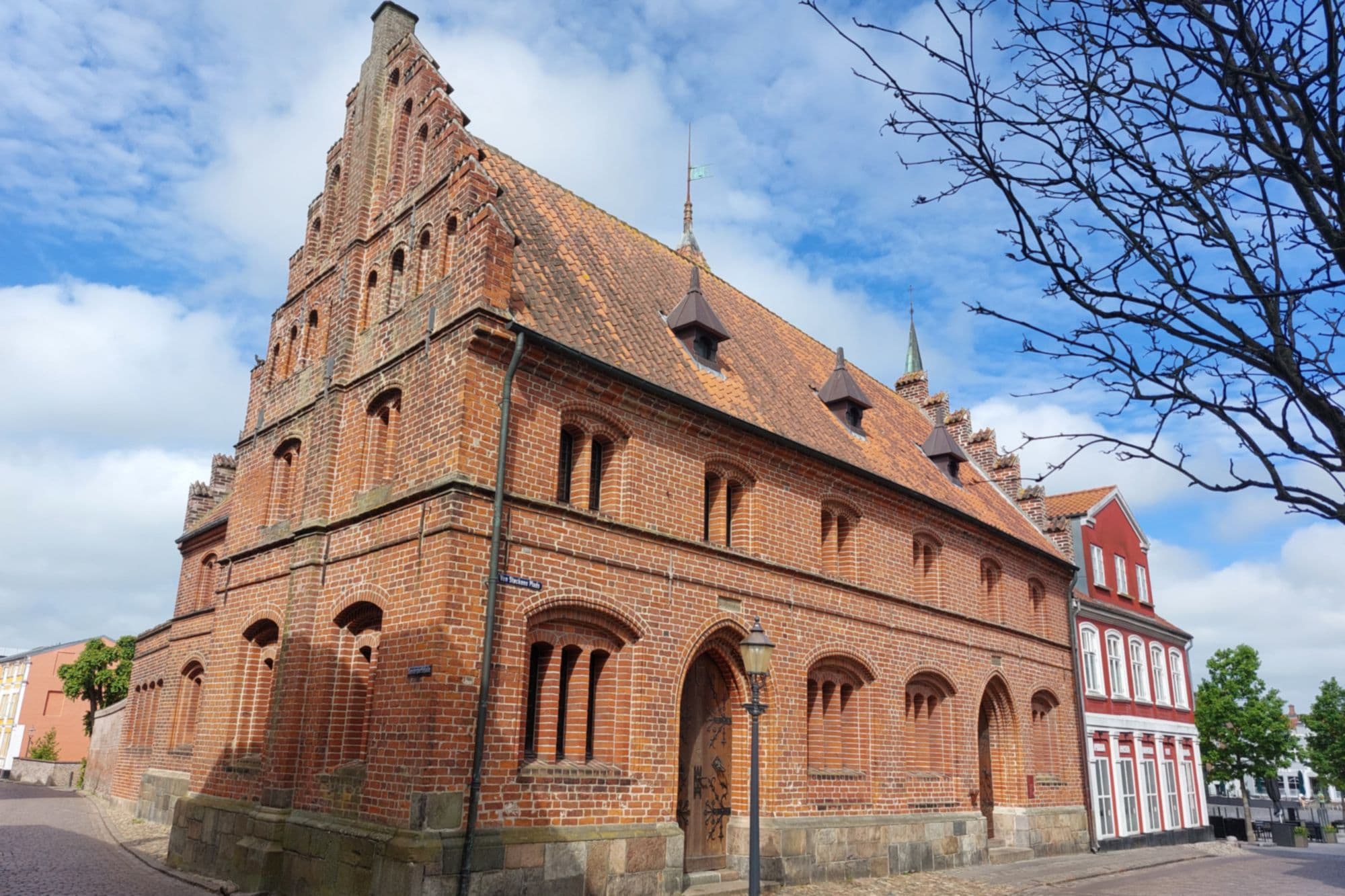
According to the city archive of the Municipality of Esbjerg, the building first appears in the records in 1496, at that time as two brick-built houses. From 1709 it was the town's town hall, court and jail; the jail wing faces the cathedral square. Since 1 January 2007 most public functions have moved out, and today the building is used for weddings and events and houses the museum exhibition Rådhussamlingen.
You often read that it is Denmark's oldest town hall. The city archive does not say so; what is documented is the age of the building, not the title. It is a photo spot either way: according to the encyclopaedia Den Store Danske, its roof carries Denmark's best-known bird's nest, a stork's nest. The photo above shows the Old Town Hall from the outside.
The courthouse and jail in Esbjerg
In Esbjerg itself the municipality holds ceremonies in the former courthouse and jail (Ting- og Arresthuset) at Skolegade 33, in the middle of the city. If you are staying in Esbjerg or travelling on to Fanø by ferry, this saves you the trip to Ribe; if you want the old town as a backdrop, choose Ribe.
On which days does the Municipality of Esbjerg hold ceremonies?
The municipality's pages do not state the wedding days consistently:
- The German and English pages for couples approved by Familieretshuset name Thursdays and Fridays, each within the window between 10:00 and 13:00; the German page speaks of Thursdays and some Fridays.
- The Danish page names selected Thursdays, Fridays and Saturdays between 10:00 and 13:00. According to this page, you always bring two witnesses of your own on Saturdays.
So plan with a Thursday or Friday morning and ask about a Saturday separately. Only the wedding office can tell you whether a particular day in Ribe or Esbjerg is possible; it is best to write by e-mail to vielse@esbjerg.dk. The municipality does not publish how long you wait for a date. We are often in touch with municipalities and ask on behalf of our couples.
Witnesses, language and interpreter
Ceremonies are held in Danish, German or English. If you do not both understand one of these languages, the municipality says you must bring an authorised interpreter. Check with the wedding office beforehand whom it accepts as an interpreter; more in our guide Interpreters at the wedding.
Two witnesses are mandatory. The municipality can provide witnesses, but not on every wedding day; the language versions of its page describe the days differently. If you bring your own witnesses, the municipality says you send their names and addresses by e-mail at least one week before the ceremony. On Saturdays and for ceremonies outside the two buildings you always bring two witnesses of your own. How other municipalities handle this is compared in our guide Witnesses in Denmark.
Getting married on the beach or at a special place
The Municipality of Esbjerg also marries couples at a place of their choice: whether on the beach, in a garden or on the water, it performs the official part of the ceremony. You bring two witnesses of your own, and for ceremonies outside the two buildings the municipality may charge a fee. The wedding office tells you the current amount; factor it in before you decide on the beach.
The coast is right there: Esbjerg and Ribe lie on the Wadden Sea, which is protected as a UNESCO World Heritage Site; Ribe is about 5 km from the Wadden Sea. Off Esbjerg lies the island of Fanø, a separate municipality with its own rules, which you reach by ferry from Esbjerg. What applies there is covered in our guide Getting married on Fanø. Which municipalities explicitly offer couples from abroad a beach, garden or boat is compared in our guide Special places to get married, and Saturdays and beaches together in our guide Saturday and beach weddings.
How it works: from the application to the ceremony
Ask the wedding office first
Before applying, write to vielse@esbjerg.dk and ask whether ceremonies are held in Ribe or Esbjerg in your period, which venue you would like, and whether the municipality provides witnesses on that day.
Apply to Familieretshuset
You name Esbjerg as the municipality and pay the fee of DKK 2,100 (about €281), which is not refunded. Both parts of the application must arrive within 14 days. The agency usually decides complete applications within 5 working days; if it asks for more documents, as of 3 November 2026 it is working on such cases from August 2026 (processing times).
Agree the date with the municipality
After the approval, Familieretshuset forwards your documents to the municipality. You then agree the date with the wedding office. If you bring your own witnesses, you send their names and addresses at least one week in advance.
The wedding day
Bring the passports you submitted to Familieretshuset, a visa or residence permit if needed, your witnesses and, if necessary, the interpreter. As everywhere in Denmark, you receive two international marriage certificates in five languages after the ceremony.
How a Danish ceremony works in detail is described in our guide The wedding ceremony in Denmark. The documents for the application are listed in our guide Documents for your wedding in Denmark, and which of them your case needs is shown by our free eligibility check.
What does a wedding in Ribe or Esbjerg cost?
Since August 2025, Danish municipalities generally no longer charge for ceremonies at the town hall, after the City of Copenhagen found in its own legal review that there is no legal basis for such fees. For a ceremony at a place of your choice the Municipality of Esbjerg may charge a fee; the wedding office tells you the current amount. In every case the mandatory cost is Familieretshuset's fee of DKK 2,100 (about €281).
Add travel and possibly a night's stay. In the Essential package (€249.99) you pay Familieretshuset's fee yourselves; in the Complete package (€649.99) it is included. Details are on our prices page and in our cost comparison 2026.
Getting there from Germany, Austria and Switzerland
By car: Ribe is about 50 km by road north of the Sæd border crossing near Tønder; you drive north on national road 11 through Tønder. Esbjerg is about 30 km further north-west. By motorway you can also reach Esbjerg via the E45 to Kolding and then the E20 heading west.
By train: the RB66 regional service runs from Niebüll in North Frisia via Tønder to Ribe and Esbjerg, depending on the connection with a change in Tønder (timetable by NAH.SH). Journey times and connections are shown by Rejseplanen and Deutsche Bahn.
Because the municipality holds ceremonies between 10:00 and 13:00, a night in Ribe or Esbjerg before the wedding is worth it if you are travelling a long way from Austria or Switzerland.
Ribe and Esbjerg as a short trip
- Ribe: according to Den Store Danske, Denmark's oldest still existing town, founded around 705 as a trading place. The cathedral and the almost completely preserved medieval street network are right by the Old Town Hall.
- Wadden Sea: the Wadden Sea off the coast is a UNESCO World Heritage Site stretching from the Netherlands via Germany to Denmark. For a walk along the dyke or a trip onto the mudflats after the ceremony, you do not have far to go.
- Fanø: the ferry from Esbjerg crosses to the island of Fanø, with wide sandy beaches on its west side.
Ribe, Esbjerg or another municipality?
Ribe suits you if you want a historic setting, would like to marry in German and are flexible about the day. Because the municipality holds ceremonies on only a few weekdays, it is worth looking at the neighbours:
| Municipality | Wedding days for couples from abroad | Good to know |
|---|---|---|
| Esbjerg (Ribe, Esbjerg) | Thu and Fri according to the municipality, individual Sat according to the Danish page | Danish, German, English; settle the days with the wedding office |
| Fanø | its own rules | separate municipality, ferry from Esbjerg |
| Tønder | Tue and Thu | close to the border; dates only 60 days ahead |
| Kolding | town hall Mon, Fri, Sat; Christiansfeld Mon to Sat | German possible; your own witnesses on Saturdays at the town hall |
| Aabenraa | Mon to Fri | dates only 60 days ahead; your own witnesses on Fridays |
More on the neighbours in our guides Getting married in Kolding, Tønder registry office and Marrying near the border. How long you wait where is shown in our wait time comparison 2026, and whether Copenhagen, Tønder or Ærø suits you better in our guide Copenhagen or Tønder. The rules of more municipalities are on our page Venues and rules by municipality.
If your approval is already with another municipality, only Familieretshuset can forward it to Esbjerg; the 4-month validity keeps running. We take care of this step as a change of municipality, more in our guide Approved but no date. Esbjerg sometimes changes its wedding days and rules, so check the municipality's current page before you apply.