
The Faroe Islands are part of the Kingdom of Denmark, but they have their own marriage rules. If you marry there, you don't apply to the Danish Familieretshuset; you contact the Faroese municipality directly, for example in the capital, Tórshavn. Here is how it works, which documents the town asks for and how the Faroes differ from Denmark. Everything is taken from the pages of the competent authorities, read on 13 November 2026.
Does the Danish procedure apply in the Faroe Islands?
No. The Danish marriage act says so itself in section 67: it does not apply to the Faroe Islands and Greenland. It can only be brought into force there by royal ordinance, adapted to local conditions. The Faroes therefore have their own ordinance on marriage, Ordinance no. 37 of 22 January 2002, which has been amended several times since. And section 18 of the Danish act expressly rules out a Danish municipality holding a ceremony in the Faroe Islands.
For you, this means the online application to Familieretshuset that you may know from Denmark does not exist for the Faroes. The Faroese municipality checks your documents itself and confirms in writing once everything is approved. So you don't need a Danish marriage approval (prøvelsesattest) for the Faroes, but it wouldn't help you there either. How the Danish procedure works is explained in our guide Familieretshuset explained.
Two more differences affect your planning. The EU treaties do not apply to the Faroe Islands (Article 355(5) TFEU). And a Schengen visa is not valid there. Both come up again below, under visa and certificate.
Who marries you and where
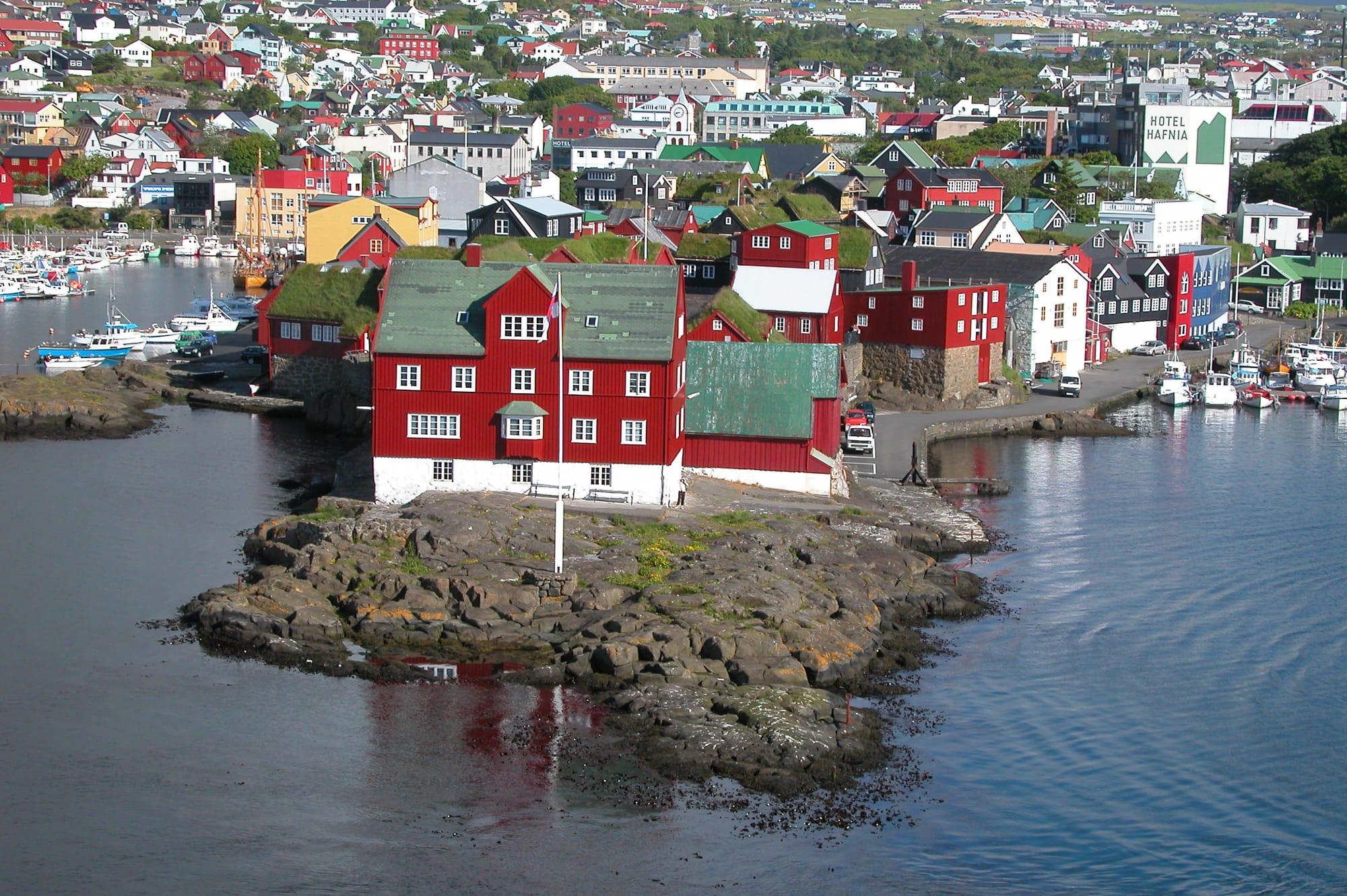
In Tórshavn, civil ceremonies take place at the City Hall (Vaglið 1). According to the town's English page, the mayor conducts the ceremony in Faroese with an English translation, and the ceremony is free of charge. According to the Faroese page, with more than 15 guests the ceremony moves to the city council chamber, which holds up to 50 guests.
Ceremonies take place Monday to Thursday from 10:00 to 15:00 and on Fridays from 10:00 to 14:00, if slots are available. The town's Faroese page also lists the first and last Saturday of each month from 10:00 to 13:00; the English page for visitors does not mention Saturdays. If you want a Saturday wedding, ask. There are no ceremonies in calendar weeks 31, 32 and 33, when much of the administration is on summer holiday, on public holidays, or from 23 December to 1 January.
Other municipalities marry couples from abroad too, for example Vága kommuna on the island of Vágar. It has its own English page with almost the same documents. For a church wedding, Tórshavn says to contact the priest of the church in question. Neither Tórshavn nor Vága mentions ceremonies outdoors in nature. If you are dreaming of an elopement on a cliff, ask the municipality before you book anything.
Documents
In Tórshavn, you first email vigslur@torshavn.fo to ask about a date and time. Important: the town says you must make the inquiry yourselves, not through a third party. Then you send the Notice of Marriage form (hjúnalagsfráboðan in Faroese), no earlier than four months before the ceremony. There are three versions: for a woman and a man, for two women and for two men. The town also asks for:
- copies of your birth certificates and passports
- a certificate of marital status that is no more than four months old on the wedding day. For the US and Canada, which don't issue such certificates, the town accepts a marriage search letter covering five years or a single status affidavit
- the final divorce decree if you are divorced
- the death certificate of your former spouse if you are widowed
- according to the Faroese page, if one of you is not a Danish citizen or lives outside the Faroes: a residence permit or visa as well
Anything not in English must be translated by an authorised translator. The Faroese page names Faroese, Danish or English as the languages of translation and exempts documents from the Nordic countries.
According to Tórshavn, your own documents generally don't need an apostille if they come from the US, Canada, Australia, New Zealand, Turkey or Europe. The exceptions are Albania, Armenia, Azerbaijan, Belarus, Bosnia and Herzegovina, Georgia, Kazakhstan, Kyrgyzstan, Kosovo, Russia, Tajikistan, Ukraine and Uzbekistan. Germany, Austria and Switzerland are not on that list.
This is the biggest difference from Denmark. There, Familieretshuset only asks for proof of single status in individual cases. In the Faroes it is always required, and it must not be too old. The town does not say which document from your country it accepts as a certificate of marital status. Check before you order one.
One more point: Tórshavn does not process name changes for people who are not registered as residents of the Faroes. You do that after the wedding where you live.
Deadlines and ID check
Tórshavn needs your form no earlier than four months and no later than four weeks before the ceremony. For a wedding in calendar weeks 34, 35 or 36, it must arrive no later than six weeks before. According to the Faroese page, processing normally takes four weeks. Once all documents are approved, you receive a written confirmation. In Vága, the Faroese page says the inquiry must arrive no later than one month before the ceremony and the form no earlier than four months before.
Neither Tórshavn nor Vága sets a deadline for showing your passports before the ceremony. Bring your passports on the day and ask, when you get the confirmation, whether the town wants to see them earlier.
If one of you needs a visa, allow more time. According to the Danish Immigration Service, a visa for Denmark or another Schengen country is not valid for the Faroe Islands. The visa sticker must state that it is valid for the Faroes, and you apply for it at a Danish mission abroad. As most journeys go through Denmark, you will often need a Schengen visa as well.
Witnesses and language
A ceremony needs two witnesses who sign the register. You send their names and addresses to the town in advance. If you don't have any, let the town know and two members of staff will witness the ceremony. The Faroese page sets a deadline of two working days before the ceremony for this. For a Saturday wedding, that page says you bring your own witnesses. Vága also provides two members of staff as witnesses on request.
The ceremony is held in Faroese with an English translation. Straight after the ceremony you receive an international marriage certificate in Faroese and English. The town does not say whether you can bring your own interpreter for another language. Ask if one of you doesn't understand English.
Same-sex marriage
It is possible in a civil ceremony. Ordinance no. 724 of 12 June 2017 extended the Faroese marriage rules to civil marriages between two people of the same sex. Tórshavn has separate forms for two women and for two men; the documents are the same. The ordinance refers to civil marriage. Whether a church wedding is possible is something to ask the church in question.
How Germany, Austria and Switzerland treat a same-sex marriage concluded abroad is covered in our guide Same-sex marriage in Denmark. It is written for Denmark, but the rules on recognition at home apply in the same way.
Certificate, apostille and recognition at home
A Danish certificate is the simple case: under EU Regulation 2016/1191 it is accepted as authentic in other EU countries without an apostille. The regulation covers public documents from EU member states. As the EU treaties do not apply to the Faroe Islands, don't count on this exemption for a Faroese certificate.
The apostille takes two steps:
- Legalisation in the Faroes: the Faroese Ministry of Justice (Løgmálaráðið) legalises a marriage certificate issued by a municipality; a church certificate goes to the Ministry of Social Affairs and Culture. Only originals with original signatures are accepted. The ministry is open on weekdays from 09:00 to 15:00. From June to August the service may be unavailable at times, so call ahead.
- Apostille in Copenhagen: since 13 December 2021, the Hague Apostille Convention has also applied to the Faroe Islands. According to Ríkisumboðið, the Danish state's representation in the Faroes, only the legalisation office of the Danish Ministry of Foreign Affairs in Copenhagen can add an apostille to Faroese documents. You pay online in advance and hand the document in in person or send it by post. Ríkisumboðið in Tórshavn forwards it free of charge if you drop it off there in person. Once received, it usually takes only a few days, plus postal time.
Germany: according to the Federal Foreign Office, a marriage concluded abroad is in principle recognised if you were both allowed to marry under the law of your home country and the formal requirements of the place of marriage were met. There is no separate recognition procedure. If one of you is German, you can have the marriage entered in the German marriage register, but you don't have to. Whether the registry office asks for an apostille and a translation is up to that office. Ask beforehand.
Austria: according to oesterreich.gv.at, the validity of a marriage concluded abroad is assessed case by case under Austrian law. Austrian citizens report the marriage to a registry office or through the Austrian representation.
Switzerland: Swiss citizens report the marriage to their Swiss representation, which passes the documents on to the civil registry authority. According to the Swiss representation in Denmark, this requires originals no more than six months old. Photocopies are not accepted.
Getting there
By air you arrive at Vágar Airport. The Faroese airline Atlantic Airways lists routes from Copenhagen, Billund, Reykjavík and Edinburgh, among others. By sea, Smyril Line's ferry Norröna sails from Hirtshals in North Jutland via Tórshavn to Seyðisfjörður in Iceland. The timetable changes with the season, so check the shipping line's website before booking.
Faroe Islands or Denmark?
Both lead to a valid marriage. But they differ at almost every step:
| Faroe Islands (Tórshavn) | Denmark | |
|---|---|---|
| Who checks | The municipality itself | Familieretshuset, for couples where not each partner is Danish, Nordic or permanently resident in Denmark; the municipality sets the date |
| Application | By email, only by the couple themselves | Online to Familieretshuset, fee DKK 2,100 |
| Proof of single status | Always, no more than four months old on the wedding day | Only if Familieretshuset asks for it in an individual case |
| Lead time | No earlier than four months, no later than four weeks before | Complete applications usually decided within 5 working days, approval valid for four months |
| Witnesses | Two, provided by the town on request | Two, depending on the municipality |
| Same-sex couples | Civil marriage since 2017 | Since 15 June 2012 |
| Visa | Own visa for the Faroes, Schengen visa not valid | Schengen visa |
| Certificate in the EU | Not an EU certificate, plan for an apostille | Valid without an apostille (EU Regulation 2016/1191) |
The Faroes suit you if you can both get a recent certificate of marital status, want to arrange everything with the municipality yourselves and the landscape is the reason for the trip. Denmark is the better fit if proof of single status is hard to get, if one of you needs a visa, or if you want to present the certificate in an EU country without an apostille. In Denmark you don't have to marry at the town hall either: some municipalities hold ceremonies on the beach, in a garden or on a boat, see Weddings at special places. Other destinations abroad are compared in our guide Marrying abroad.
We help couples with weddings in Denmark, not in the Faroe Islands; for the Faroes, contact the municipality directly.
As of 13 November 2026. Deadlines, dates and documents can change. Check them with the municipality before you book. This guide is for orientation only and is not legal advice.